Summary:
If you’ve been watching the news and wondering whether now is actually a good time to sell your gold — you’re not alone. A lot of Nassau County residents are asking the same question. Prices have surged, pulled back, and surged again, and it’s hard to know what any of it means when you’re just trying to figure out what your jewelry is worth.
This page is here to help you make sense of it. We’ll walk through what gold has done over the last five and ten years, what’s been driving those moves, and what it all means for someone in your position — practically speaking, not theoretically.
Gold Price Trend Over 5 Years: The Arc That Changed Everything
In October 2022, gold bottomed out at around $1,627 per ounce. That was the low point — a result of aggressive Federal Reserve rate hikes that made bonds more attractive and pulled money out of precious metals. A lot of people sold during that window, and many of them left significant money on the table.
Fast forward to early 2026, and gold had climbed to over $5,400 per ounce. That’s not a typo. From trough to peak, gold gained more than 226% in roughly three and a half years — one of the fastest sustained price runs in the modern gold market. In 2025 alone, gold surged approximately 50%, outperforming nearly every other major asset class.
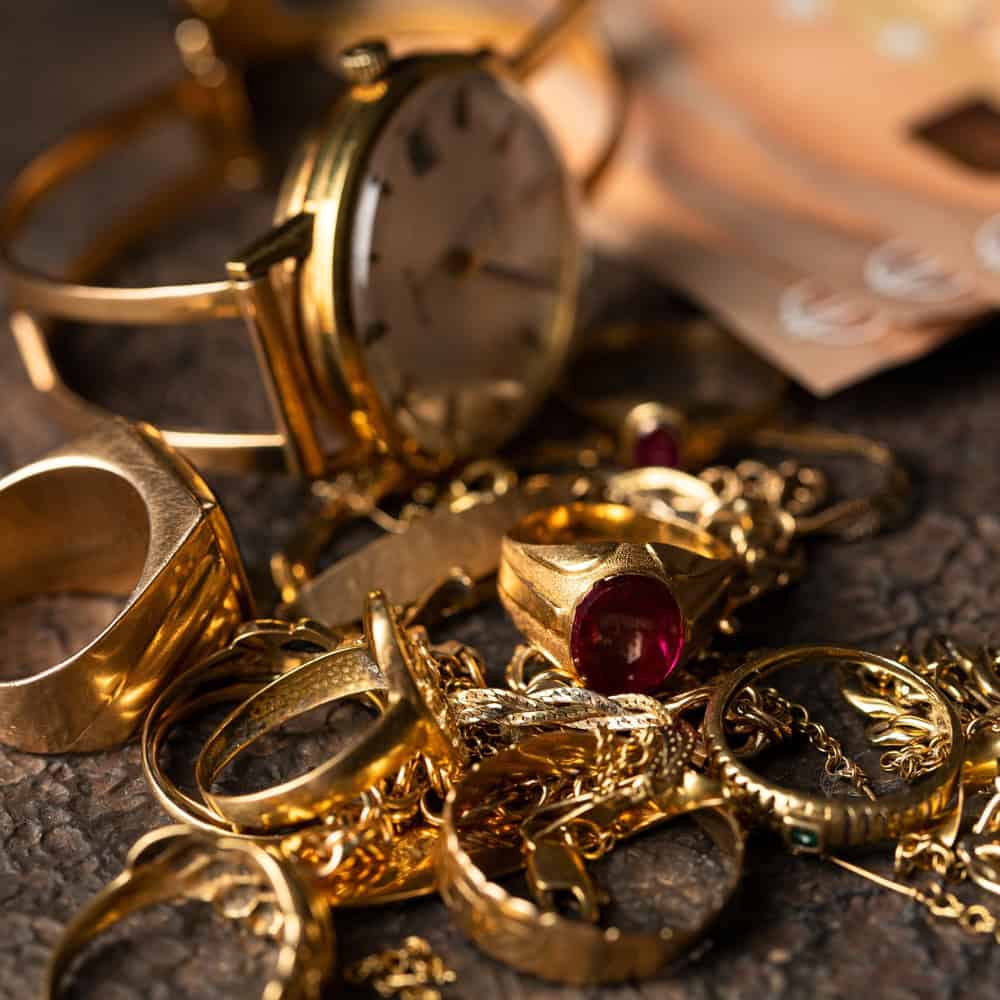
If you’re holding gold right now — whether that’s a bracelet from an estate, a scrap pile of broken chains, or a watch you inherited — the five-year price trend tells you one thing clearly: this is a historically favorable environment for sellers in Nassau County.
Gold Price Trend Over 10 Years: The Bigger Picture Behind Current Highs
Zooming out to a full decade gives you even more context. Back in 2015, gold was trading around $1,060 per ounce. By early 2026, it had reached $5,414. That’s roughly 410% appreciation over ten years — a gain that most traditional investments would struggle to match over the same period.
There were two major peaks within that decade. The first came in August 2020, when COVID-19 uncertainty pushed gold to what was then an all-time high of around $2,067 per ounce. Massive government stimulus, near-zero interest rates, and widespread economic anxiety all converged at once, and investors poured money into gold as a safe haven. That peak eventually gave way to the 2022 correction as the Fed began raising rates to fight inflation.
The second — and far more powerful — peak came between 2024 and 2026. This time, it wasn’t just one factor. Persistent inflation, a weakening dollar, escalating geopolitical tensions, and unprecedented central bank buying all piled on simultaneously. Central banks globally now hold close to 36,200 tonnes of gold, representing nearly 20% of official reserves — up from 15% at the end of 2023. That’s not speculative demand. That’s structural, institutional demand that creates a durable floor under prices in a way that fear-driven spikes simply don’t.
What makes the current environment different from 2020 is that the buying isn’t coming from panic alone. It’s coming from governments, sovereign wealth funds, and long-term institutional investors who are repositioning gold as a core reserve asset. For everyday sellers in Nassau County — people who’ve had gold sitting in a jewelry box for years — that context matters. It means the price you can get today reflects something more durable than a temporary spike.
One more data point worth sitting with: the U.S. holds 81% of its total reserves in gold. When the world’s largest economy backs its financial position with gold to that degree, it’s hard to argue that gold is just a speculative asset for nervous investors.
What Causes Gold Prices to Move Week to Week
Understanding the long-term arc is useful. But if you’re thinking about selling soon, you also need to understand what moves gold prices in the short term — because the difference between a good week and a bad week can be $50 to $150 per ounce.
The most direct short-term driver is the U.S. dollar. Gold is priced globally in dollars, so when the dollar weakens, gold becomes cheaper for foreign buyers and demand rises — pushing prices up. When the dollar strengthens, the opposite happens. You’ll often see gold dip on days when strong economic data (like a better-than-expected jobs report) comes out, because strong data signals that the Fed may hold rates higher for longer, which tends to support the dollar.
Federal Reserve language moves gold too. Any hint that rate cuts are coming tends to push gold higher. Any signal that rates will stay elevated tends to weigh on it — though as we saw in 2024 and 2025, that relationship isn’t absolute. Gold broke records even while rates remained high, because geopolitical risk and sovereign debt concerns created safe-haven demand that overpowered the rate dynamics.
Geopolitical events — conflicts, trade disputes, sanctions — can push gold up sharply within hours. The tariff announcements in early 2025 helped push gold above $3,000 per ounce almost overnight. These moves can be fast and unpredictable, which is part of why trying to time the market perfectly is usually a losing strategy for sellers.
The practical takeaway: if you’re watching gold prices week to week and waiting for the perfect moment, you’re likely to wait longer than necessary. Current prices remain near historically high levels. The window where gold was sitting below $2,000 — which felt normal for years — is well behind us. For Nassau County residents who’ve been holding gold, the conversation has shifted from “should I wait?” to “what’s the smartest way to move forward now?”
What Nassau County Gold Sellers Actually Need to Know Before Walking In
Understanding price trends is one thing. Knowing how those trends translate to the offer you’ll actually receive is another. A lot of sellers come in knowing gold is “high right now” but feeling uncertain about whether they’re getting a fair number — and that uncertainty is what bad buyers exploit.
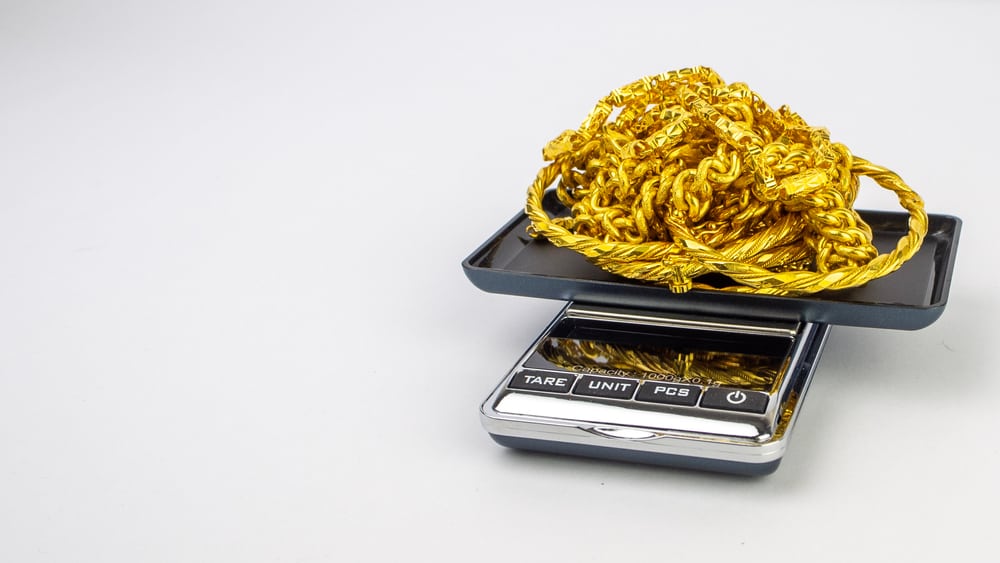
Here’s the basic framework. Gold is priced per troy ounce at 24-karat purity. Most jewelry isn’t 24K. A 14K piece is 58.3% pure gold. An 18K piece is 75% pure. That purity, combined with the weight of your item and the current spot price, determines the baseline melt value. We show you that math — not just hand you a number and wait.
At current spot prices, a 10-gram 14K bracelet carries a melt value of roughly $800 or more. That number changes daily, but the framework for calculating it doesn’t.
Is Now a Good Time to Sell Gold in Nassau County, NY?
For most Nassau County residents who are holding gold they don’t actively use, the honest answer is yes — and the price history makes a strong case for it.
Gold was at $1,627 in late 2022. It crossed $2,000 again in early 2023, hit $3,500 by April 2025, and surged past $4,300 and beyond through the back half of the year. Local Nassau County sellers were receiving spot prices in the $3,650–$3,700 range during the mid-2025 peak period, according to coverage in the Long Island Herald. Silver was simultaneously trading around $42–$43 per ounce, creating a parallel opportunity for anyone with mixed-metal pieces.
The question most sellers really want answered isn’t “is the price high?” — they can see that it is. The real question is, “what if it goes even higher?” That’s a legitimate concern, and there’s no honest answer that guarantees a direction. What we can say is that waiting for a perfect peak is a strategy that has cost sellers real money before. Gold’s 2022 correction — a drop of more than $400 per ounce from the 2020 high — is a clear example of what can happen when sellers hold out too long.
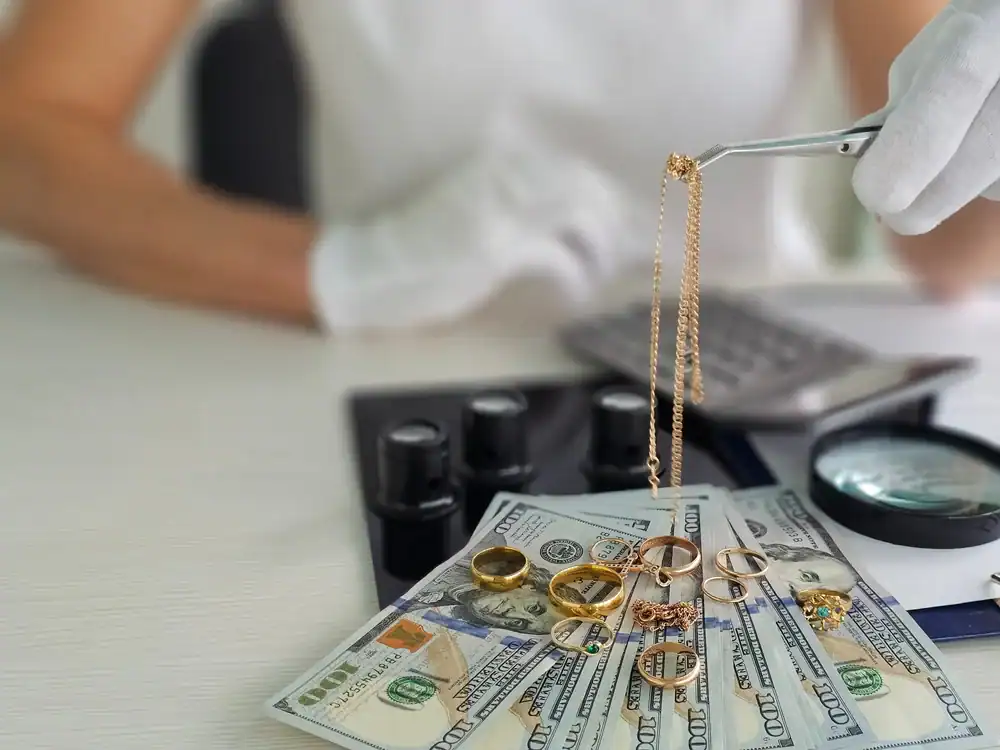
If you have gold you’re not using, getting a professional appraisal costs you nothing and gives you real information. You don’t have to sell the day you come in. But knowing what your items are actually worth — based on today’s market — is the only way to make a genuinely informed decision. We have all the equipment on-site to test and weigh your pieces in front of you, so there’s no guesswork and no black box. You see the process, you understand the offer, and you decide.
One thing worth knowing: if you’re not ready to part with a piece permanently, a collateral loan is another option. You bring the item in, borrow against its value, and reclaim it when you’re ready. No credit check. No impact on your credit score. It’s a way to access liquidity without closing the door on a piece you might want back.
Frequently Asked Questions From Nassau County Gold Sellers
**Does the condition of my gold jewelry affect what I’ll be paid?**
For scrap gold purposes, condition doesn’t matter. A broken 14K chain and an intact 14K chain of the same weight are worth the same in terms of melt value. The metal content is what we’re evaluating — not whether the clasp works or the piece is fashionable. A lot of Nassau County residents have been holding onto broken or mismatched jewelry assuming it’s not worth much. In most cases, they’re sitting on more cash than they realize.
**How do I know the offer I receive is fair?**
The simplest check is to look up the current spot price of gold before you come in, then ask us to walk you through the calculation — weight, purity, and the percentage of spot we’re offering. Reputable buyers offer somewhere between 70% and 90% of melt value for scrap gold, depending on the piece. If a buyer won’t explain how they arrived at their number, that’s a red flag. We lay out the math clearly, and you’re never under any obligation to accept an offer.
**I inherited jewelry from a family member — could it be worth more than just the gold?**
Absolutely, and this is something Nassau County residents should take seriously given the region’s history of affluent estates. A piece that looks like ordinary jewelry might be a signed designer piece, an antique with collector value, or — as one local seller discovered — a vintage Rolex worth thousands more than its metal content. We’re Rolex specialists, and we evaluate watches and jewelry for collector value, not just melt value. Getting an expert eye on inherited pieces before assuming they’re scrap is always worth doing.
**I’ve never been to a pawn shop — what should I expect?**
A clean, professional environment where you’re treated like an adult. Bring your items in, we test and weigh them on-site, and we give you an offer based on current market prices. There’s no pressure to accept, no appointment needed in most cases, and the whole process can be done in a single visit. We’ve been voted the Best Pawn Shop on Long Island by the Long Island Press — not because of self-promotion, but because the people who’ve actually been here said so.
Ready to Sell Gold in Nassau County? Here's What to Do Next
Gold prices have done something remarkable over the last five years — and that’s not hype, it’s documented market history. From a low of $1,627 in late 2022 to highs above $5,000 in early 2026, the trajectory has been one of the strongest sustained runs in modern precious metals history. For anyone in Nassau County holding gold they’re not using, that trend represents a real, tangible opportunity.
The most important thing you can do is get accurate information about what your specific items are worth at today’s prices — not a guess, not a ballpark. A professional appraisal based on actual weight, purity, and current spot price.
Gold Coast Jewelry & Pawn is located just off Jericho Turnpike in Huntington, a short drive from communities across Nassau County including Jericho, Syosset, Woodbury, and Hicksville. Stop in, bring what you have, and leave knowing exactly what it’s worth — no obligation, no pressure, and no surprises.