Summary:
You’ve got a piece of jewelry sitting in a drawer — maybe inherited, maybe picked up at an estate sale, maybe something you’ve had for years and never thought much about. Now you’re wondering if it’s actually gold. The ceramic test keeps coming up when you search, and it sounds simple enough. It is. But there’s a lot the test won’t tell you, and that part rarely gets explained clearly. By the end of this page, you’ll know exactly how the ceramic test works, what the results mean, and what to do if you want a real answer about what your piece is worth.
How the Gold Ceramic Test Works
The ceramic test — sometimes called the streak test — is a basic screening method that takes about thirty seconds and costs nothing. All you need is a piece of unglazed ceramic. The bottom of a coffee mug, a plain white tile from a hardware store, or the unfinished underside of a ceramic plate all work fine. The surface needs to be rough and unglazed — that’s what makes the test work.
You drag the piece across the ceramic with light, steady pressure and look at what it leaves behind. A gold-colored streak means the metal is likely real gold. A black or dark gray streak means it probably isn’t. That’s the test. Quick, accessible, and useful as a first pass — but not the whole story.
Ceramic Test for Gold: What the Streak Color Actually Tells You
The science behind this is straightforward. Gold is softer than ceramic, so when you drag it across an unglazed surface, it deposits a thin layer of material. Real gold leaves a warm yellow or gold-colored mark. Base metals — copper, brass, iron — leave a dark streak, often black or grayish. That contrast is what makes the test useful as a quick filter.
What it can’t tell you is the karat. A 10K piece and an 18K piece will both leave a yellow streak. The test confirms presence of gold, not concentration of it. And that distinction matters a lot when it comes to value — because 10K gold (41.7% pure) and 18K gold (75% pure) are priced very differently at the current spot rate.
There’s another limitation worth knowing. Gold-plated or gold-filled jewelry can also produce a yellowish streak because of the thin gold layer on the surface. If you press harder or streak the same spot twice, you may start to see a darker color underneath where the plating has worn through — but this isn’t always obvious, and it’s easy to misread. A piece can pass the ceramic test and still not be solid gold.
This is exactly why the ceramic test is best understood as a starting point, not a verdict. It’s reliable for ruling out obvious fakes made entirely of base metal. It’s not reliable for confirming purity, identifying plating, or giving you any real sense of what a piece is worth. For that, you need a different kind of evaluation entirely.
Red Flags That Mean the Testing Process Isn't Being Done Right
Whether you’re testing at home or watching a dealer test your piece, there are a few things that should give you pause. The most common one: relying on a single test. A dealer who runs a magnet over your piece, gets no reaction, and immediately makes you an offer hasn’t done enough. Modern counterfeit gold pieces are increasingly made with non-magnetic metals specifically to pass that test. The same goes for weight — sophisticated fakes are now manufactured to match the expected density of real gold.
A trustworthy testing process involves more than one method. At minimum, you’d expect a visual inspection, a scratch or ceramic test, and some form of electronic or chemical verification. Each method catches different things. Skipping steps isn’t efficiency — it’s either laziness or an attempt to keep you in the dark about what you actually have.
Watch for reluctance to explain what’s happening. A professional should be able to tell you what each step involves and what they’re looking for. If the testing is happening behind a counter where you can’t see it, or if the person testing your piece can’t explain why they’re doing what they’re doing, that’s a problem. You’re the one handing over something potentially valuable. You’re entitled to understand the process.
Rushed evaluations are another red flag. A proper assessment of a gold piece — especially one with a hallmark that needs verification — takes a few minutes, not thirty seconds. If someone is moving too fast, they’re either skipping steps or they’ve already decided what they’re going to tell you regardless of what the test shows.
Gold Analysis Today: What Professional Testing Actually Looks Like
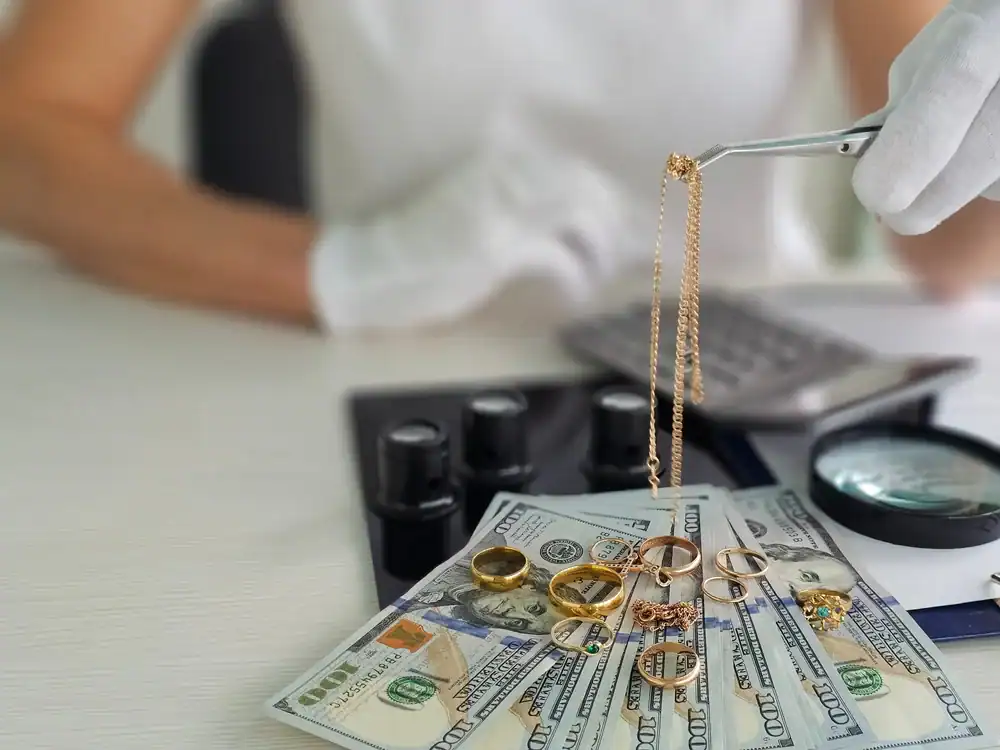
Professional gold analysis goes well beyond what any home test can do. Where the ceramic test tells you real or probably not real, professional methods tell you exactly what you have — the purity, the composition, and in many cases, the precise market value based on current spot prices.
The most common professional method used in retail settings is electronic testing, which measures electrical conductivity to estimate purity. It’s fast, non-destructive, and accurate enough for most standard pieces. For higher-value items or anything where exact purity matters, XRF analysis — X-ray fluorescence — is the standard. A well-calibrated XRF machine can measure gold content to within a fraction of a percent without touching or damaging the piece at all.
How Acid Testing and XRF Analysis Compare for Purity Verification
Acid testing has been used in the gold trade for a long time, and it’s still a reliable method when done correctly. A small scratch is made on a touchstone, and acids of different strengths are applied to determine how the metal reacts. The reaction — or lack of one — narrows down the karat range. It’s more precise than the ceramic test, but it does require a small surface mark and some technical knowledge to read the results accurately.
XRF analysis is the more advanced option, and for good reason. The machine emits X-rays that interact with the metal’s atoms and return a reading of the elemental composition — how much gold, how much silver, how much copper, and so on. For a 14K piece, you’d expect roughly 58.3% gold and a mix of other metals making up the rest. The machine confirms or challenges that within seconds, without any contact with the piece itself.
The practical difference matters for sellers. An acid test gives you a karat range. XRF gives you an exact percentage. When a dealer is calculating an offer based on weight, purity, and spot price, that precision can translate directly to a difference in the offer. Knowing your piece is 14K is useful. Knowing it’s 58.6% gold versus 57.9% is the kind of detail that only comes from professional-grade equipment.
Fire assay — the most accurate method of all — achieves precision to one part in ten thousand, but it destroys the sample in the process. It’s used primarily in refineries and laboratories, not in retail settings. For the vast majority of jewelry evaluations, XRF provides everything needed without any risk to the piece.
What Nassau County Gold Sellers Should Know Before Getting an Evaluation
Nassau County has a deep history with fine jewelry. The North Shore communities — Great Neck, Manhasset, Roslyn, Glen Cove — have been home to significant wealth for over a century, and that history shows up in estate collections, inherited pieces, and vintage jewelry that’s been sitting in households for decades. A lot of the gold circulating through Nassau County was purchased or gifted at a time when jewelry standards were different, and pieces may carry European hallmarks rather than the U.S. karat stamps most people recognize.
European pieces often use millesimal fineness markings instead of karat numbers. A stamp reading 750 means 18K. 585 means 14K. 417 means 10K. If you’ve inherited a piece with an unfamiliar number on it, that’s likely what you’re looking at — not an indication that something is wrong with the piece, just a different labeling system. Knowing this before you walk in for an evaluation means you won’t be caught off guard if a dealer references those numbers.
Gold prices have been near historic highs through 2024 and into 2025. For Nassau County residents who’ve had gold sitting untouched for years, that’s worth paying attention to. A piece that felt like costume jewelry a decade ago might carry real value today — and the only way to know is to have it properly tested and weighed against the current spot price.
We work with sellers from across Nassau and Suffolk Counties, and one thing that comes up constantly is that people underestimate what they have. Chains, rings, old coins, broken clasps — all of it has weight, and weight has value when the gold content is confirmed. The evaluation itself is straightforward and takes only a few minutes. There’s no pressure to sell, and if you’d rather take a collateral loan and hold onto the piece, that’s an option too — we offer up to 70% of item value on loans with no credit check required.
Getting Your Gold Properly Tested in Nassau County, NY
The ceramic test is a reasonable first step — it’s fast, free, and can rule out obvious fakes. But it stops well short of telling you what your gold is actually worth. For that, you need professional testing: equipment that measures real purity, a process you can watch and ask questions about, and someone who can connect the results to a fair, current-market offer.
That’s what a proper evaluation looks like. Testing done in front of you, explained as it happens, with results that mean something concrete. No guessing, no black-box process, no pressure to decide anything on the spot.
If you’ve got gold you’re curious about — inherited pieces, old jewelry, coins, anything — we at Gold Coast Jewelry & Pawn have been helping Nassau and Suffolk County residents get real answers for years. Voted Best Pawn Shop on Long Island by the Long Island Press, and with professional testing equipment on-site, we’re set up to give you a clear picture of what you have and what it’s worth today.