
Summary:
If you’ve been watching TV on Long Island lately, you’ve probably seen the commercials — drop your gold in an envelope, mail it in, and wait for a check. It sounds easy. But there’s a lot happening between the moment you hand your jewelry to a shipping carrier and the moment (if ever) you see payment. Nassau County residents are selling gold at record rates right now, and not all of them are getting what their pieces are actually worth. This page walks you through the real differences between online gold buyers and local dealers — what to watch for, what questions to ask, and how to protect yourself no matter which route you choose.
Online Gold Buyers vs. Local Dealers: Understanding the Trust Gap
The appeal of online gold buyers is real — no driving, no face-to-face negotiation, no pressure in the moment. You request a kit, pack your items, and ship them off. But the moment that package leaves your hands, so does your leverage. You can’t ask questions, you can’t watch the testing process, and if the offer comes back lower than expected, you’re already on the back foot.
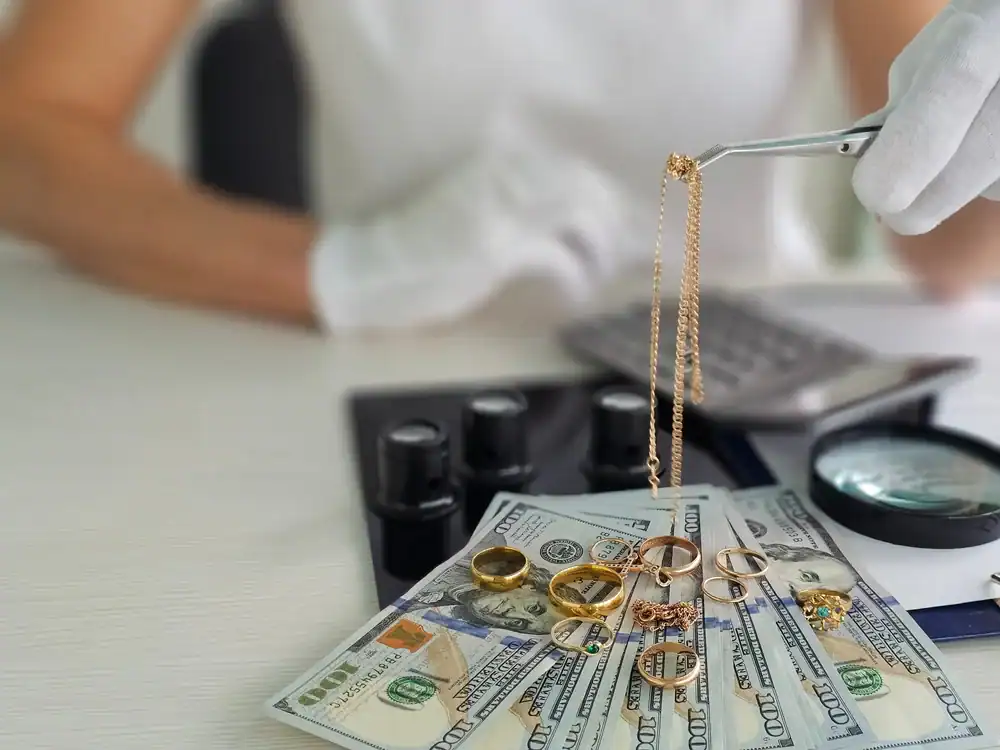
We work differently. When you walk into our shop, you’re in the room when the scale is read and the purity is tested. You can ask how the number was calculated. You can say no and walk out with your item. That’s not a small thing — it’s the entire difference between a transaction you feel good about and one you spend weeks second-guessing.
Local vs. Online Gold Selling: What Happens to Your Price When No One's Watching
Here’s something most online gold buying services don’t advertise: the offer you see in the commercial is rarely the offer you receive. Online buyers price in risk — risk that the item is misrepresented, risk that it gets lost in transit, risk that you dispute the offer and they have to return it. All of that uncertainty gets factored into a lower payout for you.
We don’t carry that same risk. We test in front of you and can see exactly what we’re working with before we make an offer. That transparency tends to produce better prices, not worse ones — which is the opposite of what most people assume going in.
Gold prices move in real time. A reputable local buyer like us will reference the current spot price openly and show you the math: weight multiplied by purity percentage, multiplied by the spot price, minus our margin. It’s not complicated once someone walks you through it. But you can only have that conversation in person.
The karat stamp on your jewelry — 10K, 14K, 18K — tells you what percentage of it is actually gold. A 14K piece is 58.5% gold by weight. An 18K piece is 75%. We test in front of you with professional equipment and show you exactly where your offer comes from. That’s the kind of transparency that builds trust, and it’s simply not possible through the mail.
What to Ask Any Gold Buyer Before You Commit — Local or Online
Whether you’re considering a local shop or an online service, a few direct questions will tell you almost everything you need to know about whether a buyer is worth your time.
Start with testing. Ask where and how your item will be tested, and whether you can be present when it happens. A legitimate local buyer will say yes without hesitation. Professional shops use XRF analyzers or acid testing kits — both reliable methods — and a good buyer will explain what they’re doing while they do it. If a buyer can’t or won’t let you watch, that’s worth noting.
Ask about the offer timeline and what happens if you decline. With a local buyer, you can decline on the spot and leave with your item. With a mail-in service, declining usually means waiting several more days for your item to be returned — and some services charge a return shipping fee when you say no. That fee is one of the most common complaints logged with the BBB against online gold buying services, and it’s a detail that rarely appears in the advertising.
Ask about licensing. New York State requires pawnbrokers to be licensed under General Business Law Article 5, and Nassau County has its own layer of consumer protection oversight on top of that. Licensed buyers maintain transaction records submitted to local law enforcement. It’s a level of accountability that online-only buyers — many of whom operate with no physical address and no local regulatory presence — simply don’t have. Asking to see a license isn’t rude. It’s smart.
Finally, ask how long the process takes. We can complete an appraisal and make an offer in well under an hour. If you’re happy with the number, you leave with cash the same day. That timeline is difficult for any mail-in service to match.
Mail-In Gold Buyers: The Shipping Risks Most Sellers Don't Find Out About Until It's Too Late
Shipping gold jewelry through the mail carries more risk than most people realize going in. USPS, FedEx, and UPS all cap their liability for uninsured jewelry at around $100 under standard shipping terms. That means if your package is lost, damaged, or arrives with different contents than what you sent, your recovery options are extremely limited — regardless of what the mail-in service’s marketing materials say about their insurance coverage.
Proving a loss is also harder than it sounds. The burden of proof falls on the sender, and without documentation of exactly what was in the package — weight, purity, photos, independent appraisal — a claim can be nearly impossible to substantiate. It’s a situation that’s far easier to avoid than to resolve.
The FTC has issued consumer warnings about mail-in gold buying services specifically, and the BBB has logged thousands of complaints against them nationally. The most common issues — low-ball offers after the item is already in their possession, packages that arrive “damaged,” offers that bear no resemblance to the advertised price, and return shipping fees that feel punitive — follow a consistent pattern.
The scam doesn’t always look like a scam. Sometimes it’s a legitimate-seeming company with a polished website and a free prepaid envelope. The problem isn’t always outright fraud — sometimes it’s just a business model built on the fact that once your gold is in their hands, you’re negotiating from a position of weakness. The offer comes in lower than expected, and many sellers accept it simply because the process of getting the item back feels like more trouble than it’s worth.
Red flags worth watching for: no verifiable physical address, no licensing information displayed, vague language about how items are tested, aggressive pressure to accept an offer quickly, and any mention of return shipping fees. Legitimate buyers — local or online — don’t need to trap you into accepting an offer. We make a fair one and let you decide.
If you’re in Nassau County and you’ve already sent items to an online buyer and something feels wrong, the Nassau County Office of Consumer Affairs is a resource worth knowing about. They handle complaints involving deceptive business practices and can help you understand your options. That kind of local recourse doesn’t exist with an out-of-state online buyer who has no presence in New York.
Why Nassau County Sellers Deserve a Better Experience Than a Prepaid Envelope
Nassau County is one of the wealthiest counties in the United States, with a median household income that consistently ranks in the top ten nationally. That’s not a small detail when it comes to gold selling. It means a significant portion of the people in communities like Great Neck, Garden City, Manhasset, Roslyn, Oyster Bay, and Syosset are sitting on real estate — in the form of fine jewelry, estate pieces, and luxury watches — that deserves more than a form letter and a check in the mail.
A lot of gold selling in Nassau County comes from estate liquidations. Someone passes away, and family members are left with jewelry they’ve never worn, pieces they can’t identify, and no real frame of reference for what any of it is worth. That’s a situation that calls for a real conversation with someone who knows what they’re looking at — not a prepaid envelope and a waiting period.
The same applies to people selling out of financial need. One of our customers came in after seriously considering an online payday loan. Her sister suggested selling jewelry she no longer wanted instead. She walked out with cash the same day, and later described the experience as one where she felt genuinely comfortable and informed — not pressured or judged. That outcome isn’t guaranteed anywhere, but it’s far more likely when you’re sitting across from a person who can answer your questions in real time.
We’ve been serving Nassau and Suffolk County residents for years from our location at 1786 E. Jericho Turnpike in Huntington — right along the corridor that connects both counties. Most people who come in are in and out in about 15 minutes. The Long Island Press voted us the Best Pawn Shop on Long Island, and our 4.8-star rating across 74 reviews reflects what that experience actually looks like in practice. That’s not something you can replicate with a shipping label and an automated offer.
Selling Gold in Nassau County? Here's What to Do Before You Decide
The bottom line is straightforward: online gold buyers aren’t always dishonest, but the structure of the transaction puts you at a disadvantage the moment your item leaves your hands. Local buyers who test in front of you, explain the math, and let you walk away if you’re not satisfied offer something that no mail-in service can — control over the process.
Before you ship anything, know what your gold is worth. Get a free in-person appraisal. Watch the testing happen. Ask questions. If the offer is fair, take it. If it isn’t, you leave with your item and nothing lost. That’s how a trustworthy transaction should work, and it’s the standard Nassau County sellers should hold any buyer to.
If you’re ready to find out what your gold is actually worth, we’re a short drive from most Nassau County communities and open seven days a week. Come in, see the process for yourself, and make your decision from a position of knowledge rather than uncertainty.